In the realm of energy science, the hydrogen produced by directly driving water splitting with solar energy is vividly referred to as liquid sunlight. The realization of this vision relies on simulating a stable and precise artificial sun in the laboratory. For researchers, establishing a high-performance evaluation system is the first step in their work, and the cost of a xenon lamp-based water-splitting hydrogen production system is often a central topic in project initiation and budget planning. In fact, the cost of such a system is not merely about hardware assembly but is a comprehensive pricing of photon capture efficiency, airtightness management, and data credibility. A mature hydrogen production system typically consists of a simulated light source, a reactor, an online sampling unit, and a chromatographic detection system, with each component’s technical refinement directly influencing the final experimental output.
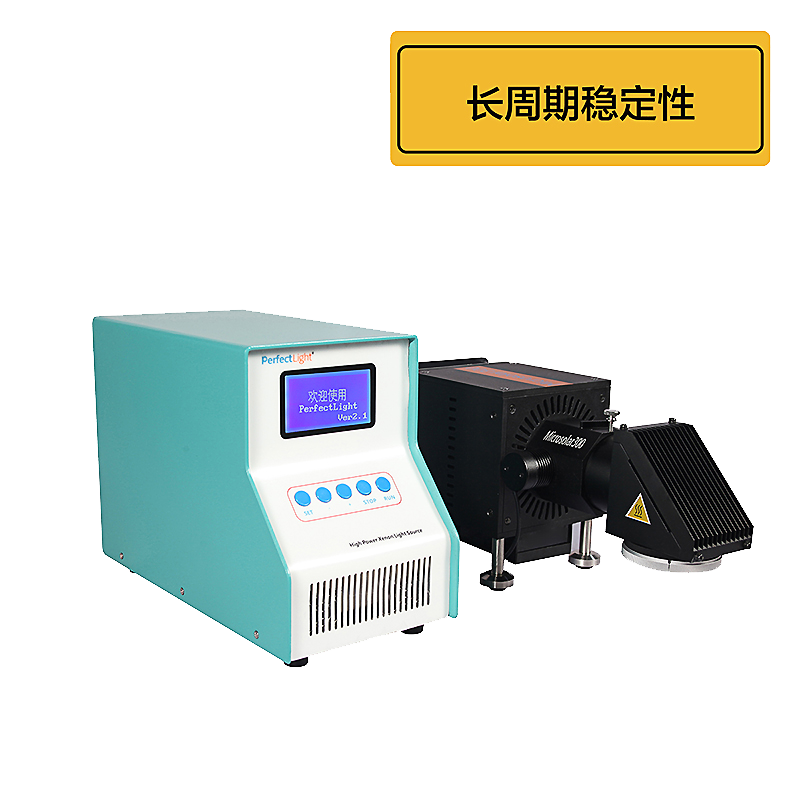
When discussing the cost structure of the system, the xenon light source as the core energy source holds a crucial position. The water-splitting reaction fundamentally involves the generation of photo-generated charge carriers when the material absorbs photons with energy exceeding its bandgap. To ensure that experimental results are comparable across different times and laboratories, the simulated light source must possess extremely high spectral matching and temporal stability. For example, the Microsolar 300 xenon light source incorporates core solar simulator technology (TSCS) and a precision digital power management system. This technical solution can control long-term irradiation instability within ±3%, effectively avoiding light intensity decay caused by lamp aging or voltage fluctuations. For researchers, this stability means that the measured hydrogen production rate has higher kinetic reliability. Although the initial investment in an optically feedback-integrated light source is slightly higher than basic equipment, the assurance it provides for long-term stability experiments significantly reduces the time cost of scientific repetition.
If the light source determines the upper limit of energy input, then the reaction system and sampling units determine the lower limit of data acquisition. The hydrogen and oxygen produced by water splitting are typically at the micromolar level, demanding near-perfect airtightness. To completely eliminate interference from ambient air infiltration and ensure that the product strictly matches the theoretical 2:1 stoichiometric ratio, advanced evaluation systems often use highly chemically inert materials. In this context, the Labsolar-IIIAG online photocatalytic analysis system demonstrates its depth as a professional evaluation terminal. This system adopts an all-glass design, eliminating the possibility of gas adsorption by metal pipelines. Moreover, it features a passive magnetic high-speed circulation pump with a speed of no less than 4000 r/min, ensuring that gases within the system reach kinetic equilibrium within 10 minutes. This precise control of trace gases allows researchers to achieve standard curve regressions with R² > 0.999, providing solid experimental data for calculating the apparent quantum yield (AQY). When assessing the cost of related products, the integration of complex glass processes and passive driving technologies is key to reflecting the equipment’s professional value.
Additionally, another crucial factor influencing the overall system cost is the level of automation. Traditional knob control or manual sampling methods, while cost-effective, cannot avoid human error in long-term, tens-of-hours stability experiments. Modern precision equipment tends to incorporate lower-level control or PC-based software integration, enabling closed-loop management of vacuum pump operation, automatic valve switching, and chromatographic sampling. This automation relies on the collaborative work of high-precision sensors and electromagnetic actuators, not only improving the accuracy of Faradaic efficiency calculations but also freeing researchers from tedious manual sampling, allowing them to focus on material mechanism design. Furthermore, whether the system supports AM 1.5G standard spectrum fitting and has comprehensive safety protection mechanisms (such as fan fault protection, overload power cut-off, etc.) are also important criteria for determining the system’s long-term operational reliability.
As hydrogen research shifts from millimeter-scale sample screening to square-meter-scale Hydrogen Farm strategies, the value of the evaluation system extends from mere mechanistic exploration to engineering efficiency assessment. In the real natural light fluctuation environment, verifying the dynamic response characteristics of catalytic materials requires the testing platform to have stronger environmental adaptability. In summary, discussing the cost of xenon lamp-based water-splitting hydrogen production systems is essentially about finding the optimal balance between research efficiency, data precision, and financial investment. By integrating systems like the Microsolar 300 and Labsolar-IIIAG,
Recommended
news